
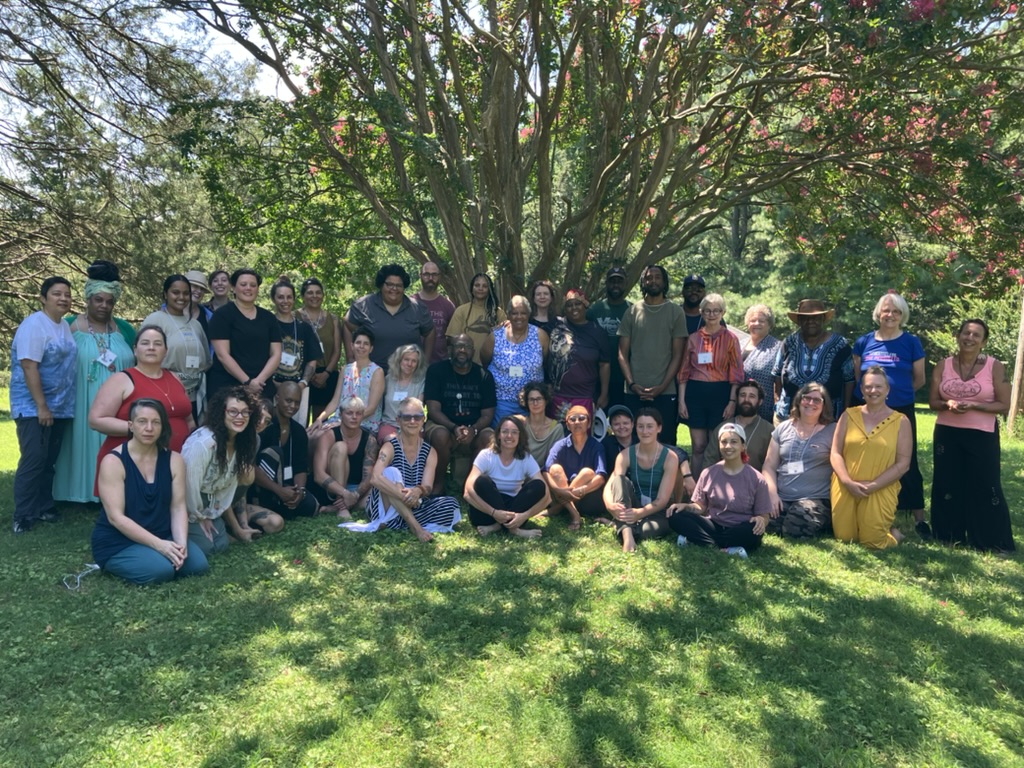
Years ago, Sister Evelyn Mattern captured the mission and vision of Peace Hill with the following statement: “Unless action arises from spirit, it’s empty. And if spirit claims all the territory and never gets its hands dirty in the marketplace, it too is empty. I don’t know that I’ve integrated those things. But I’ve quested after it.”
Sister Evelyn’s words highlight the inherent connection between action for justice in the world and spiritual practice, a connection embodied by longtime activist and friend of Peace Hill, Karen Ziegler.
Karen is the organizer and founder of Democracy Out Loud, a group of activists who have been championing democracy and resisting authoritarianism through peaceful protest for the past nine years. Like Karen, many members have decades of experience with social justice organizing.
A unique feature of Karen’s leadership is her emphasis on contemplative practice and spiritual support for activists and organizers. Karen explained that as an ordained minister and practicing Buddhist, she is attuned to the relational connections among activists and the energy of their meetings and actions.
“I do really approach this organizing community kind of the same way that I would approach a religious or spiritual community,” she said. “What’s important is the energy of how we gather, what it feels like to be together.”
In addition to weekly Zoom organizing meetings attended by over 75 members, Karen also leads weekly virtual meditations for activists.
“That’s sort of the beating heart of this‚ in some ways,” she said. “This practicing activist community is a group of people who just drop in and know how to ground themselves, to ask for help, and be open to help from the unseen world and from each other.”
Karen explained that though most members of the group aren’t Buddhists, they’re able to draw spiritual resources from Buddhism that support their organizing. Karen’s own need for sustaining practices as a spiritual and social justice leader led her to discover Buddhism. Her desire to deepen her spiritual practice in a way that connected to the struggle for a more just world drew her to the teachings of Buddhist minister, author, and activist Lama Rod Owens.
“I feel like I’ve always had a practice that has helped me to survive being in this world,” she said. “What I found in Buddhist communities, especially after Trump was elected in 2016, was that they were kind of ‘business as usual.’ There were a lot of white people who just didn’t seem to connect their practice with what was actually happening in the world. And so, fortunately, that was about when I found Lama Rod.”
Lama Rod, the author of Radical Dharma and other books, emphasizes the indigenous roots of Buddhism, integrating earth-based and ancestor-based practices into his teachings. Discovering Lama Rod’s writings helped Karen better understand that not only can spiritual practice support activism, her practice must be connected to her work in the world.
“I had to bring all of it,” she said. “I had to bring my activism that I had been doing as an LGBTQ feminist organizer years ago. I had to bring my sense of urgency about what was happening in the country.”
Karen stressed that the goal of spiritual practice is not to become more content or comfortable. Instead, practice often involves leaning into discomfort, as it allows activists to better understand their connections to the earth and each other, as well as how systems of violence operate, clarifying the importance of relationships and collective resistance.
“They’re very connected for me, the work of organizing, which is all about relationships and community, in alignment with something bigger, with an ethical framework,” Karen said. “That’s the thing that Buddhism does provide that secular mindfulness doesn’t… It’s not about the individual. None of this is about any individual. It’s about all of us trying to get free. So, I feel like our practice individually has to be in alignment with that understanding.”
While Lama Rod has an international following, he has found a particularly significant audience among activists in Durham.
“I know that we have many people who practice with Lama Rod living here in Durham,” Karen said. “He probably has the largest group of practitioners who hang out with him online here than anywhere.”
In addition to virtual opportunities for practice, Lama Rod has led multiple in-person retreats at the Avila Center for Community Leadership in Durham, co-organized by Peace Hill and Bhumi Durham, a group of activists led by Karen.
“To do a residential retreat is something that we’ve always hoped to do, and we’re really, really grateful for [Peace Hill’s] help in making it happen,” Karen said.
Though Lama Rod’s upcoming November retreat at Avila is currently full, Karen emphasized that he is also hosting a BIPOC-only (Black, Indigenous, and People of Color) gathering on Wednesday, November 11. Both events will serve as impactful resources that help sustain the work of local activists. Karen clarified that while these retreats are restorative, spiritual practice also takes work and commitment, and gatherings like those led by Lama Rod are important opportunities for that work to happen.
“It takes so much work, and if you do the work, and I’m talking about the spiritual practice of being connected to something, and understanding the power of love, kindness, and connection – I think when we do that work, our organizing has a lot of love and joy in it, and that’s what will sustain us, and continues to sustain us as things get more intense, which they probably will, but we can get through to the other side. There will be another side.”
Follow this link to subscribe to the Democracy Out Loud newsletter: https://substack.com/@democracyoutloud